Availability
Record the planned production time and unplanned stop time within the agreed cell boundary. Keep planned changeover, breaks, cleaning and scheduled maintenance separate.

Production performance
A practical guide to accepted output, OEE boundaries and downtime coding for trigger capping cells with feeders, conveyors, inspection and downstream interfaces.
Answer first
Trigger capper OEE should be calculated only after the cell boundary, planned production time, ideal rate and accepted-good-pack definition are agreed. Keep availability, performance and quality visible as separate measures, then classify downtime by the stage that caused it: bottle supply, cap feeding, orientation, dip-tube entry, placement, pre-threading, tightening, inspection, reject handling or downstream blockage.
Overall Equipment Effectiveness is commonly expressed as Availability × Performance × Quality. The combined percentage is useful only when the underlying definitions remain stable and the selected ideal rate is supported by the actual format and operating conditions.
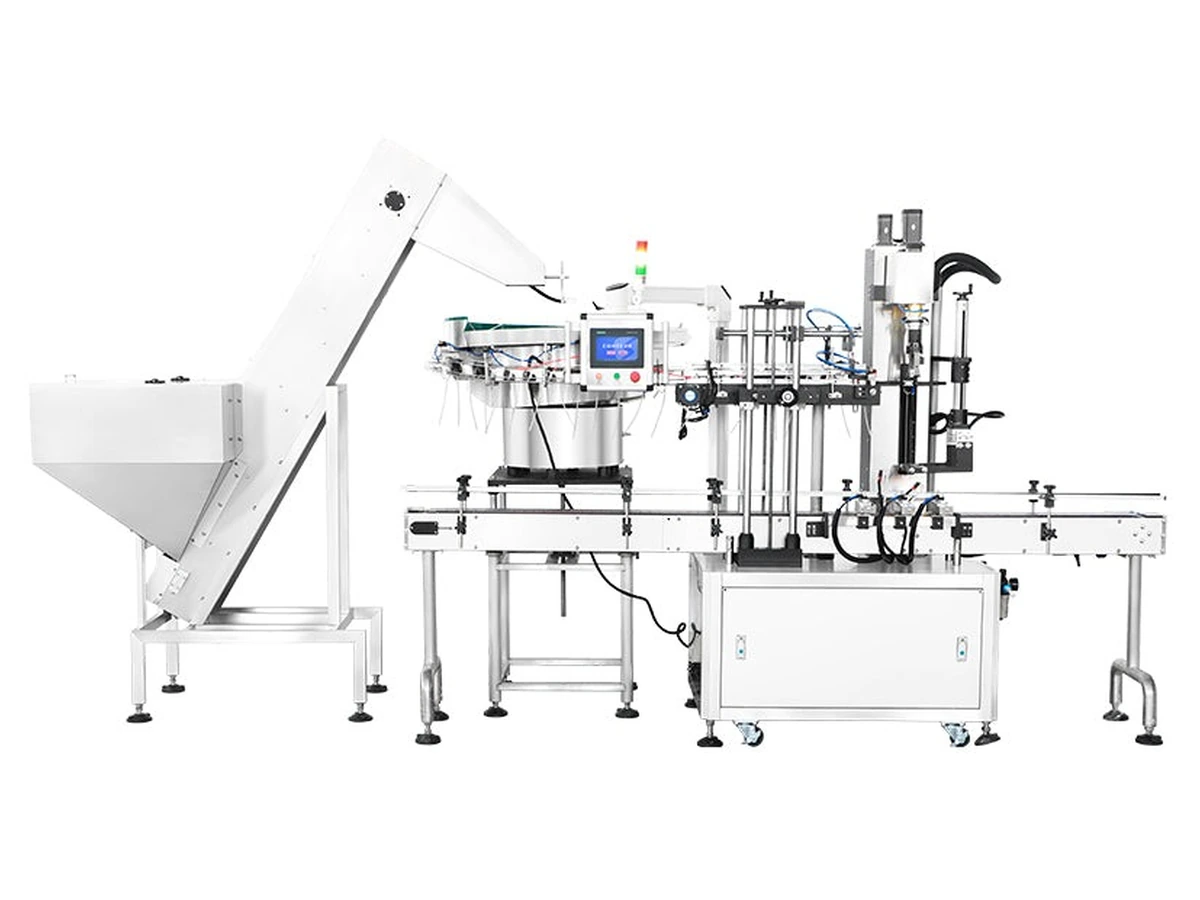
Cell boundary
A stop cannot be assigned consistently until the measurement boundary is clear.
| Area | Example loss category | Evidence to retain |
|---|---|---|
| Bottle supply and infeed | Starved conveyor, unstable bottles, gaps, fallen bottle or incorrect spacing. | State duration, bottle format, upstream condition and operator action. |
| Closure loading and feeder | Empty hopper, bridge, tangled tubes, orientation loss, track blockage or insufficient buffer. | Closure lot, load level, feeder state, reject/recirculation condition and recovery. |
| Placement and tube entry | Missing closure, misplacement, tube catch, bottle not present or transfer fault. | Sensor/alarm, retained pack, video or observation and affected component identity. |
| Pre-threading and tightening | Cross-thread, high cap, bottle rotation, tool slip, abnormal torque or damaged closure. | Settings, tool condition, cap height/torque result and first-off approval. |
| Inspection and reject | False reject, missed defect, full reject bin or unconfirmed rejection. | Inspection result, reject confirmation, defect category and disposition. |
| Downstream line | Labeller or conveyor blockage, accumulation full or line stop request. | Interface state, duration, blocked/starved reason and restart sequence. |
Core measures
Record the planned production time and unplanned stop time within the agreed cell boundary. Keep planned changeover, breaks, cleaning and scheduled maintenance separate.
Compare actual cycles or accepted output with an agreed ideal rate for the same bottle, trigger, dip tube, feed method and quality condition. Do not use an unsupported headline speed.
Use accepted good packs after the agreed checks, not simply closures applied. Record rework, rejects and packs held for inspection separately.
For improvement work, the stop minutes, stop count, accepted packs and defect categories are often more actionable than the single OEE percentage. Preserve the raw evidence so the combined result can be explained.
Loss tree
Separate replenishment delay, bulk tangling, orientation loss, track blockage and downstream stop response.
Code tube catch, tube damage, missing closure, incorrect angle and bottle-position faults separately.
Separate cross-threading, high cap, insufficient engagement, bottle rotation and tooling/contact issues.
Record planned changeover, adjustment, inspection and approval time rather than hiding it inside unplanned downtime.
Identify upstream starvation and downstream blockage so the capper is not blamed for losses outside its boundary.
Buyer questions
Include them when the feeder is inside the agreed capping-cell boundary. Keep the feeder cause visible so replenishment, tangling, orientation and track faults can be improved separately.
Use an agreed rate supported by the actual format, feeder, operator duties, accepted-quality criteria and stable operating evidence. Do not use a catalogue maximum that the complete line cannot sustain.
Define the site rule before reporting. First-pass accepted packs, reworked packs, rejected packs and held packs should remain separately visible even if a later disposition releases some material.
Use automatic state data where available and define a consistent threshold or category for manual logging. Frequent short stops can reveal feeder or transfer instability even when total downtime appears small.
Only with context. Bottle stability, trigger geometry, dip-tube behaviour, changeover requirement and approved rate can differ. Report format and production conditions alongside the result.
Consider machine states, feeder demand, starved/blocked conditions, alarm and stop reason, reject confirmation, counters, format/recipe identity and the ability to export or review data required by the site.
Use the production run log, accepted-output guide and controls and data guide.
Send the format range, shift pattern, target accepted output, operator duties, feeder scope, line interfaces and current stop or reject data.